Episode Transcript
[00:00:00] Speaker A: Predict predictable predictions.
[00:00:01] Speaker B: Predict predictable predictions.
[00:00:03] Speaker A: Predictable.
[00:00:03] Speaker B: Predicted Predictable.
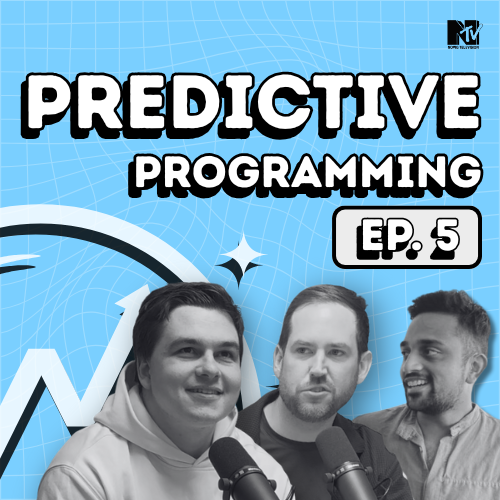
[00:00:10] Speaker A: Predictive Programming Episode five and once again, we have Adi Raja Prabhakaran in the house.
[00:00:17] Speaker C: Not going to try that last thing.
[00:00:19] Speaker A: I. I got it this time. I'm good. Once I realized the second half is basically baccarat, I was like, oh, yeah, that's like a baseline 50% grade. I can get a C minus on this thing.
I want to get straight into parlays. RFQ parlays. I think they're very interesting.
[00:00:35] Speaker C: Wait, before we get into that.
[00:00:36] Speaker A: Okay, fine. What do you got?
[00:00:37] Speaker C: Okay. The definition of a peer is a person of the same age, status or ability as another specified person.
Look, I defended you on Twitter the other day.
[00:00:49] Speaker B: Thank you.
[00:00:51] Speaker C: And I have to come to the other person's side now because when you post something like, jannik, Sinner is my peer, it comes off as so disingenuous, it discredits almost everything else you post. And this is what I would argue.
[00:01:04] Speaker A: Now you're saying this as somebody who likes what Adi posts and you're trying to help him post better.
[00:01:09] Speaker C: Yes. Yes. What I would say is I think.
[00:01:11] Speaker A: Often we don't communicate.
[00:01:12] Speaker C: Yes.
[00:01:12] Speaker A: Yes.
[00:01:13] Speaker C: Why not make the argument that this, yes, Sig is not my peer, but PMs are going to be better, which I think you illustrated in your article reading again, than a sportsbook, because you can have multiple different market makers come and compete and the theoretical hold will decline. But these market makers are not my peer. And trying to tell me otherwise, it feels like as if you're lying to me, coming at it from the angle that, like, hey, yes, it's similar to a sportsbook, but it's going to be better because the holds are going to be lower. They have to be lower because they're competitive. And if you actually pool enough resources, you could theoretically compete, but you as an individual can't compete. Why not come in from that angle?
[00:01:55] Speaker B: Well, I wrote what I wrote because. And like, this is. I have to be honest, like, it was provocative. Like, I think that's part of, you know, he's provoked. Yeah. Getting the message fired up out there, getting people reading. You know, I, I want people to click on it and I want people to read it. But I also do believe that the, the point here is actually I'm the Yannick sinner of predicting what's going to happen in the Senate.
I'm the Yannick sinner of Senate WIP counts. So when you go on Calshi and you trade it against me or trade against me on predictim, you were betting against the best of the best for predicting the specific thing. And this kind of segues into maybe a broader point is that yesterday's takers are going to be tomorrow's makers. Right. If you were really, really good at pricing WNBA props or like, you had a great parlay engine pricer and you were able to, like, find those, like, weird edges where DraftKings wasn't able update their parlay price when you added a different leg. I've heard about all these kind of angle shots that people have found. If you're that kind of person who can do that, you're not going to be taking on Kalshi in the future. Very soon, you will be the maker and the flow, the fish will come to you and bet against you and you'll collect all the EV from the spread and your pricing advantage. So I think when people are like, oh, this.
They're not conceptualizing the idea that because they were betting on DraftKings and FanDuel, they were forced to be the taker. They had no other option. So they have to play this cat and mouse game of getting accounts, getting banned, getting limited, and that's all going to go away because you are not going to be the taker anymore. If you're that good, you are going to be the maker and you're going to love it because you're going to get amazing flow. You're going to get amazing liquidity rebates from Kalshi and volume rebates and you're going to print money and you don't have to worry about, like, messaging, like, Ukrainian, like, war Dodgers to, like, move your accounts into something in Russia. And, like, you know, I don't know if you know who I'm talking about when I say that, but, like, one of my good friends has that guy. Or, like, go to Australian frats and, like, get them to make accounts, like.
[00:04:00] Speaker A: A lot for me.
[00:04:00] Speaker C: He's good. He's solid.
[00:04:01] Speaker B: Yeah.
Yeah. He gives me locks every week. Yeah.
So it's just like that. Maybe you can be the Yonek center of your thing and you're not going to be the Onyx center of everything. And I'm never going to be the Onyx center of call options on Palantir, but everyone can be. And so when I say Yonik Sinner is my peer, if he downloaded Kalshi and started trading on the Senate, he would be my peer. And that's kind of like my point here. And so I get why your people are mad.
Whatever.
[00:04:31] Speaker A: I want to segue I want to, I want to do an artful segue. Although I can't stop thinking about Zelensky being like, hey, I'm getting paid by America on Monday, so I can pay you on Tuesday. But anyway, there's a guy, I think he just goes by prediction market trader or something. There's a guy who's like live streaming himself, doing prediction markets.
[00:04:50] Speaker B: Yeah, he's a star. I love him.
[00:04:52] Speaker A: And he vibe coded a RFQ parlay pricer and said check this out and did a little bit of it. And then he, he stopped quoting them. He said it wasn't working that well. I was doing things like offering plus 400 on Saquon anytime plus Montgomery anytime or some. Something that was like plus 250. Fair.
[00:05:17] Speaker C: Right, right.
[00:05:18] Speaker A: But just proof of concept.
That is such new territory. That's a guy, he doesn't have the skills yet to be fighting. But it's. You never even had a chance to try and do that in the past.
And it's going to be the idea that, you know, I could line up to start quoting those RFQs and I say, hey, I'm not getting filled. Let me comment it in from the other way and see what people are offering here and being like, oh, I get plus 400 here. Like we've talked about, you know, adding wrinkles to games to make them interesting. And yeah, yeah, this is the big inefficiency that is super interesting. And I've talked to so many of the big global market making groups. Nobody is built to do this. I shouldn't say nobody, hardly anybody is built to do this. This is really fun new territory and I think we'll be the place where for the time being, it will longest be true in sports that a little guy could compete with a big.
[00:06:23] Speaker C: Well, here's the thing. I got a question for you, Addy. I hope you know the answer.
What happens if I bet a Saquon Barkley Dave Montgomery anytime touchdown parlay and I bet it on Friday and on Saturday Saquon Barkley is ruled out and then David Montgomery scores a touchdown. What happens to my price? Because that is going to blow up in people's faces unless we have a clear answer and it's handled correctly.
[00:06:47] Speaker A: So what happens?
[00:06:51] Speaker B: Okay, let's edit this out if I'm wrong. But I think what happens is that they're doing the last traded price on that leg and then extrapolating that into the rest of the bet, which I fully don't fully understand yet.
[00:07:04] Speaker A: It sounds very in my brain correlation Vulnerable.
[00:07:07] Speaker B: Yeah.
[00:07:07] Speaker C: Yes.
[00:07:08] Speaker B: And expectedly. But it is their solution. Yeah, we. Let's.
[00:07:11] Speaker A: We should back up. I think most people still don't know what RFQ even.
[00:07:15] Speaker C: Okay. Yeah.
[00:07:16] Speaker A: And we have a smart guy and it's not either of us.
[00:07:19] Speaker C: Yeah.
[00:07:20] Speaker A: So why don't we start there?
[00:07:21] Speaker C: Yeah, fair enough, fair enough.
[00:07:22] Speaker A: Why don't you explain what an RFQ parlay system is?
[00:07:25] Speaker B: Okay. Yeah.
[00:07:25] Speaker A: And what we're talking about here.
[00:07:27] Speaker B: Yeah, I'm happy to. So RFQ stands for request for quote. And it is a very standard kind of way of getting your money down in the broader financial system. If you want to buy like a gajillion Japanese government bonds, you'll go to a bank, you'll submit an rfq and then a bunch of banks will come and say, oh, you want to buy a gazillion? Like here's your price for that. And then you choose one. Right. Or multiple. And so the thing is like an RFQ system for bonds, for example, it will all. It's like semi automated, but there's always, you know, some trader who's like making sure that the quote is good and they're not getting run over. And when you say that, is it.
[00:08:08] Speaker C: Close to OTC in the financial world or no?
[00:08:11] Speaker B: I think so. This is great question. I think it's kind of OTC being.
[00:08:15] Speaker A: Over the counter, which is an even more direct.
[00:08:18] Speaker B: Yeah.
[00:08:18] Speaker A: Hey, what would you pick up the phone?
[00:08:21] Speaker B: And I pick up the phone when.
[00:08:23] Speaker C: I worked at the family office, like what I would saw the traders would do, it's like if, if the boss wanted to buy like, like 50 million worth of swaps or something like that, they would be messaging 20 brokers over the counter. So is, is that kind of what's happening here or.
[00:08:38] Speaker B: Yes, but I'm a very atomized and micro version of it because it's. Instead of like one guy wanting to buy fifty million dollars of bonds, it's. It's fifty million people each wanting to buy a hundred dollars or ten dollars of parlays. And so it's not worth having a person on your trading floor who will pick up the phone. And for every parlay and book, it obviously doesn't scale. So what they, what Kalshi has built is a system that will, when you go on the app and you click this leg, this leg, this leg, it will automatically send a request to all the market makers for a setup which includes really smart, sophisticated people, but apparently also predm trader, which is amazing.
Everyone will get a few seconds to like submit their bid for what? For this parlay.
[00:09:24] Speaker A: I think it's three seconds.
[00:09:25] Speaker B: Yeah. And so then the person on the app can just like choose to fill it or not. And so this is kind of gonna be all automated. It has to be because if you want to respond in 3 seconds, you have to have your engine, your pricing engine set up to respond to an rfq, get all the data, come up with the number and put it, and put the size all automatically. And so that's, that's how this works. And anyone can do it apparently.
[00:09:51] Speaker C: Yeah, yeah.
[00:09:52] Speaker A: And there are, there are a ton of tiny little details to the decision. Both like from how. Because everybody's going to do this, right?
[00:10:02] Speaker C: The.
[00:10:02] Speaker A: Let's talk about.
[00:10:03] Speaker C: Let me back up, hang on a second.
I played around with it a little bit. I tried just doing like a two, a basic two leg parlay, like the spread in the total, the price there is very, very known because both legs come from extremely efficient markets. We know what the correlation is and I know they're testing it out. But it was interesting to see like when I typed in 20 bucks gave me an offer, 200 gave me an offer, 2000 said unavailable and it didn't give me an offer.
So how does this work? And then another question I would ask is, first thing, anything that I thought is, let's just say hypothetically that on Friday night I know that Patrick Mahomes is going to get ruled out. So the Chiefs, whoever the Chiefs are playing, let's say they're playing the Cowboys. The Cowboys spread and the Cowboys under, both extremely good, both extremely correlated. It's going to be a great price. Could I not just spend all night clicking 20 bucks at a time spamming them or build a bot that does that and take these market makers for everything they've got. What, what protections do market makers have and Kalshi have against that? And how does the size also work into the rfq?
[00:11:13] Speaker B: Yeah, it's a great question. So this is all about risk management from the market makers themselves when they're trading against you and I and we built this at Kelshi Trading. I had very sophisticated tools to be able to see where my risk was at any given moment. What happens if inflation comes in this hotel? It moves my Fed position that way. I sell this way on CPI and everything's all connected and correlated. So when you blow out their system by wanting $2,000 in a parlay, which by the way means like they have to put up $20,000 or something right.
[00:11:44] Speaker A: On that, it'd be like 6,000 or something? Yeah, it's like +260, right?
[00:11:47] Speaker B: Sure. So they in their pricing, pricing is not just about fair value. Pricing is also about risk management.
And so when even if they think it's a really good bet that they want to take, but they already have 5,000 exposed to it and they don't want to add to it, they will just quote a higher price to the point where, okay, it becomes worth taking warehousing that extra risk on top of it. So this is the new limiting, right. You used to be limited based on your skill and your adversity to a single dealer, the sports book. Now you'll be limited to by the available liquidity in the market. If you're that good and you see a really juicy spot to hit and you want to put $10,000 on this parlay, market makers of course are going to be like, whoa, whoa, whoa, like this guy, it's probably Chris, right? Like, and then the other thing is that even if you do it piece wise, little bit, $20, $100, $20, like that's smart. And that is exactly what happens in like modern financial markets. People try to like hide in the order book and in the order flow.
[00:12:50] Speaker A: And that's so a lot.
[00:12:51] Speaker B: They'll figure that out. It's their job to realize that's what you're doing.
[00:12:54] Speaker A: And the details of the implementation of. Is every new parlay put together like a brand new RFQ experience, naive to past experiences, the way you implemented or after the first rfq on this combination, do you create an order book and everybody who posted a quote, their order by default lands on that order book. And now you can kind of see like, oh, this filled at plus 850, but their orders at plus 700, plus 600. Like those vary.
There are a ton of implementation choices that like our team right now is working through. What have they done? What are we going to do that change the way a lot of this works and stuff. Like if everybody agrees, oh, this spread and this total are so efficient and you start noticing that, oh, all of the parlay volume does not feed back into the pricing on the straight market, obviously people are going to start running game.
[00:13:50] Speaker B: Yeah. And that's exactly what Jane street does all day.
That's exactly what it is.
[00:13:56] Speaker A: So yeah, that's why that, that is one of a million reasons why this is going to be so much fun. I know what we're personally going to do. And this is similar to how we trade right now.
We would have 24, seven automated systems with like hard caps of exposure to individual outcomes based on like their correlation. Right. So like there's just only so much over Travis Kelce receiving we'll take but Sunday morning we'll have a human being.
[00:14:24] Speaker C: Wait a second.
[00:14:25] Speaker A: Evaluating case by case. That's when the real volume.
[00:14:27] Speaker C: So let's give an example there. So is Travis Kelsey over the same thing as Rasheed Rice under?
[00:14:39] Speaker A: So like you can make this or my home's homes you can make this decision different ways. What we tend to do just for like simplicity of the data model is Kelsey receptions and receiving yards over are all the same thing and are completely unrelated to Mahomes passing over. But then we set the caps with the knowledge that like that's not actually true. We you know like you have some understanding of how football works to be like don't actually set this to your max limit.
But then yeah, on, on Sunday in that golden hour from 9am to 1pm and we're working on this like real time, like seeing a full range of every possible price. We would consider every price this combination is traded at. How risky are we willing to be on this? At what point will we say this has gone crazy and we're actually going to start firing the other side? Like that's very cool. I don't know what the fees are though right now or what everybody else is going to do and I, I suspect it will end up a super high fee product everywhere because how could it not be? Which would be the one kind of wet blanket on the whole thing.
[00:15:47] Speaker B: But well, yeah, if Kashi is looking at the data and they're seeing holy shit, we're delivering so much fish to the fishermen they're going to come for their tax. You know, of course they will like and you're still going to do it because you're going to be you know, think of like in the Big short when Jared Bennett is talking to Jeremy Strong's character and Jeremy is like how are you fucking me? And Jared's like I'm not fucking you, I'm making love to you. You're getting the entire Sunday and I'm just getting the cherry on top. Right. Because pricing is the harder part. You deserve most of the Sunday for doing the hard part of taking the risk and pricing. And yeah, like Kalshi, they're going to blow a gajillion dollars on marketing and they're going to get the fish onto the platform and you get to go fishing and, and you get to go home and have a feast. So like you know, you're just gonna have to pay for that. It's not. There's no free lunch.
[00:16:38] Speaker C: When I was looking at the. I know it's kind of still in like beta testing right now, but when I was playing around with it, it kind of sucks. Like the prices are awful.
They're not competitive at all. Liquidity is dog shit right now. How far away until we are an actual product where like any regular Joe Schmo can go in and click $20 and actually get a price that's in the ballpark of a fanduel draftkings, etcetera, etcetera.
[00:17:07] Speaker B: I think we're less than a month away from that.
The amount of money that's being printed. I have the data right here. The win rate, the money, it's. It's just going up and up. It's exponential. I look at Novig's data and parlay volume is about 30% of the volume. You do? Yeah.
Oh yeah. Oh yeah. You can edit that out if I.
[00:17:28] Speaker A: Wasn'T supposed to say no, I mean it's good it.
[00:17:30] Speaker B: You know. Yeah.
[00:17:31] Speaker C: Damn.
[00:17:31] Speaker A: Any investors who want it?
[00:17:33] Speaker B: Yeah.
So. So let's just put. Okay.
[00:17:37] Speaker A: And then keep slashing hold to like you know.
[00:17:39] Speaker B: Yeah. And for context we're trying to get ready for this.
[00:17:42] Speaker C: Except when you parlay Clemson and Penn State moneyline together.
[00:17:45] Speaker A: Well so I mean I would kind of bear post a little bit because of things like that. Like I there is when you have an exchange and fees actually hide this no fee makes it more egregious.
Let's say there are two money lines that are trading minus 110. Both sides. They're both 5050 coin flips. Any user can go put up plus 109 available. And now you got two plus 109s. That does not mean if you parlay those together that somebody else is obligated to give you better than plus 300 for five dimes. That's crazy. And you will just never be able to deliver that product.
[00:18:25] Speaker C: Yeah, I understand that. I'm just saying it looks bad.
[00:18:29] Speaker B: Okay.
[00:18:29] Speaker A: People. Yeah. People are not used to it and do not like it. And there. There will be a. There will be some converging from both sides on this.
[00:18:36] Speaker B: Two important points here. One, well, I think parlays are going to be. If Novig is a good model. 30% of the volume. Yesterday Kalshee did broke the $300 million in a single day barrier on total volume. Yeah, total volume across Kalshee.
[00:18:52] Speaker C: But people's love of prediction markets and not sports.
[00:18:55] Speaker B: Yeah. 96% of the volume was sports. Okay, that's fine, sure, whatever. And then, but then this is the other thing is that when you look at DraftKings pricing, that is the pricing given a lack of adverse selection.
[00:19:10] Speaker A: I know that's the thing.
[00:19:11] Speaker B: Think about it. They've banned all the good ones. So of course they can give really good prices to the bad traders. Now that this system is going to be more adverse selection, the spreads are going to be wider. And for that reason the prices structurally should never approach, should never really fully catch up to DraftKings. Because DraftKings price, what you see on the app is a fake price. It's a price distorted by the fact that they control the entire ecosystem.
[00:19:39] Speaker A: But it is also maximally extractive. And so I think to summarize it, nobody knows whether the impact of this is much harder to market make and thus I must, must price more safely and this is much more competitive, therefore I must price more aggressively. We don't know where the equilibrium is going to end.
[00:20:01] Speaker B: It's happening day by day. It's. People are fighting for that.
[00:20:04] Speaker C: Can you give us what is the whole percentage on, on the 30% of your volume on parlays?
[00:20:08] Speaker A: No.
[00:20:09] Speaker C: Okay.
[00:20:09] Speaker A: I can't. It's, it's not wildly different than what you see in public disclosures from sportsbooks.
[00:20:16] Speaker C: So now I'll ask you then Addy, five years from now all the market makers have competed. It's an extremely efficient place, including Kalshi's fee.
What is my hold percentage? If I'm a square, I'm a fish and I want to go place a $100 parlay on like a four leg, 13 to one same game or multi leg parlor. What's my hold?
Your hold or sorry, how much am I losing?
[00:20:42] Speaker B: I mean what you're asking, the less the hold is, the more efficient the market is. So in an extremely efficient market, the hold is lower. In a less efficient market, the hold is going to be higher. Right. So.
[00:20:54] Speaker C: Well that is true, but like I would argue saying what's the five, five year, what's my.
[00:20:59] Speaker B: Where do you think we end? It's just it, it's going to.
If it's like NFL Moneyline parlays, it's going to be unbelievably efficient. Right. It's going to be extremely tight and you're going to get. In fact, I think the biggest users of that product will be sportsbooks themselves. Think about that. You're the trading team at DraftKings. You have this captive audience or your bet365 in England or whatever and you have all this exposure suddenly and you're looking at your book.
Okay, like I don't want this. So let me go to Kalshi and create a parlay or rfq something that will help me warehouse or offload this risk.
[00:21:35] Speaker A: Look, the reality is money never comes easy.
[00:21:37] Speaker B: Yeah.
[00:21:37] Speaker A: In this business especially you always have to evolve either side of the counter. Well if it gets too efficient then you got to build new product to get.
[00:21:45] Speaker C: Simply asking is like I would argue that like for player props that that theoretical hold can never go lower than like 5% because you, I would just, I wouldn't, I wouldn't market make something if a player props if I was going to get like less than 5% because the toxicity of the adverse selection is gonna kill me. And for parlays if they allow like too many glitches, which they're going to be for people to come in and parlay one leg over. If that hold is like 3%, it's just not worth it to me. So I would imagine, my guess would be it can't be lower than like 7% because it's just way too toxic of a flow.
[00:22:23] Speaker B: Yeah, I think it'll get competed down to the point where all the market makers are like I can't do any better than this. Right. And then it'll be the edge for like one of the market makers to think oh I found this. I'm actually I can price a little tighter than the only other other market makers and they'll make all the money from there. So it just going to get computed down and the, and the people and it's going to get more and more efficient and the money is going to be made by the people who make it more efficient.
[00:22:52] Speaker C: Wait, I think Henry said something of four. So can I.
Okay, can I see all the other market makers offers on this? So for example, if I make a basic two leg parlay, Bengals spread and bangles total, for example, can I see that? Hey, this market maker offered plus 250, this one offered plus 245 etc. Etc. Because you know my conspiracy brain would think how do I know that like Couchie isn't just giving all the RFQ flow to Kalshi trading and hiding. Oh they were the best price conveniently every time.
[00:23:30] Speaker B: You can't, I don't know about if because like the way the RFQ system works is that it matches the orders directly and it's not, it's not exactly like an order book where everyone Just sets resting orders. So if there, if it was like that, like the typical Kalshi product or contract, then you can see everyone else's bids, but the bills are public, you.
[00:23:51] Speaker A: Can'T see what it executed at. So if somebody executed a worse price than you, you could raise hell about it for sure.
[00:23:56] Speaker B: Yeah, that's exactly what.
[00:23:57] Speaker A: I don't know.
[00:23:58] Speaker B: They would never get away with.
[00:23:59] Speaker A: I don't know.
[00:24:01] Speaker B: Structurally impossible.
[00:24:02] Speaker A: I don't know what they do at speed though. And speed is interesting. Now we have this nice, like we'll rarely have this as an issue because we have, we have very fine ticks. With wide ticks you have a lot more collisions because there's only a few, we haven't even gone to the B2B side of this. There's a few vendors that sell this data who are in a position to increase their valuations and different, different ones are doing different quality jobs of leveraging that right now, from what I can tell.
But it is interesting because, you know, you offer everybody three seconds to get out there, but if two sources quoted the same number and it. Does it actually matter if who is faster? Because obviously in a regular order book it does.
But there is some kind of like expectation with an RFQ that you're setting some minimum amount of time.
[00:24:48] Speaker C: Yeah, actually it is a good question.
[00:24:49] Speaker B: So is it price time deterministic within the.
[00:24:51] Speaker A: Yeah, I don't know.
[00:24:52] Speaker B: I, I don't know. Yeah, I, I, I think it should be. That makes sense if, if it takes me 1.5 seconds but you 2.5 seconds to get to the same price, I deserve the fill.
[00:25:01] Speaker A: There's a lot of, like, there's a lot of upside because of the way, because usually the whole first thing. Right. Assumes like the market has been open kind of indefinitely. Right?
[00:25:11] Speaker B: Yeah.
[00:25:11] Speaker A: Whereas if this is. No, I'm waiting to alert you.
You kind of want to guarantee people There are three seconds because, for instance, I can give you 5,000 in quantity if you give me the three seconds. If I have to win on speed, I'm going to come up with a number that I only want to offer 250 in quantity on because I use my worst algorithm to come up with it. So there are some product reasons to maybe like do a blended fill kind of thing. And that was another piece, you could say that the user has to say set quantity on the request first. That's not what they're doing. Because it's bad customer experience.
[00:25:42] Speaker B: No, it is, I thought, No, I.
[00:25:43] Speaker A: Think as soon as you put the legs Together you get a previewed price.
[00:25:45] Speaker C: Yeah, okay.
[00:25:46] Speaker B: All right, all right. It's both. So when you are setting up the legs, it auto fills the number 10 for you in the thing.
[00:25:53] Speaker A: Okay.
[00:25:54] Speaker B: So it's auto as you choose every, like it's sending to the market makers. Hey, 10, $10, $10.
[00:25:58] Speaker A: Which is functionally like zero.
[00:26:00] Speaker B: Yeah. The mark and the market makers. There's also like a tag on that RFQ where it's like, hey, it's just the initial probe. Someone is building this right now. Right. And then so they can kind of like get started. And then when they change the price from 100 to 1, from 10, the quantity from 10 to 100, that then sends a new RFQ and a new race to price it. And one important quirk about it is that if you're the market maker, you must fill the entire size. There's no partial fills as of right now. I think that, that that should change maybe because it's more efficient if like one, if multiple market makers can come together and fill a big order.
[00:26:40] Speaker C: Yeah, that is because there are whales out there that actually want to bet like fifty hundred thousand on like a five.
[00:26:47] Speaker B: I think they will just have to do one thousand at a time for now. But, but that is the way it works. Like there's, it is price, time and size deterministic, Right. Or sorry, I should say it's at least size deterministic. I don't know about the time within the three second window. It's a. Interesting detail that I'll, I'll, I'll ask my contact.
[00:27:08] Speaker A: There's a lot of slippery. You could do something like, like kind of discreetly to the user, take their order and sit it on an order book and let it get filled.
[00:27:17] Speaker C: What if, like, what if they actually just straight up brought the limits out where like say I see on Sunday morning I have like five different NFL games and I parlor them all together. I mean like we talked about, this is going to be the most efficient price. The odds of this is a toxic flow is almost zero percent here and I won a hundred thousand. That's a lot of risk to warehouse.
Could some market maker not come back and say, hey, we'll call you. 50,000 at this price or 25,000 at this price. And then like they're effectively limiting me.
[00:27:51] Speaker B: Yeah, I think that's what's going to happen. That is effectively what is happening when you're using the app. If you put in 100,000, all the market makers are like, who the fuck is this guy? Yeah, and then you put anonymously.
[00:28:00] Speaker C: Yeah.
[00:28:00] Speaker B: So it's fair.
[00:28:01] Speaker A: They're not saying because I know your last name.
And they can do that. Because an order book does get generated. I don't know if it. You have to execute. It might just get generated on the lookup. But it's trivial to create an order book for this thing. The discoverability is very low. The likelihood that somebody actually comes in and takes the counteroffer are very low. But the mechanism does exist.
It's something I'm trying to see if we can avoid doing that. I feel like it's better if it all happens strictly RFQ and you aren't and you don't end up with this graveyard of order books. Because what I found talking to people in prediction market world is they're like querying for the existing parlay order books that are filled and quoting them. And if they don't come from sports, they don't understand. Like, no lookups are everything.
Forget the history. You have to sit there waiting for tickets to be put together. And so, you know, anything you can do to, like, funnel people into where the volume is, is good.
[00:28:51] Speaker B: But, dude, if the fish are there, people will figure it out.
[00:28:54] Speaker A: They'll figure it out.
[00:28:55] Speaker B: You don't have. Kelshi's not gonna have to do much more work than bringing the fish. Everyone else is gonna learn all.
[00:29:00] Speaker C: Okay, one. One less thing there. So I would make the argument that right now Kalsha isn't bringing the fish. Robin Hood's bringing the fish.
[00:29:07] Speaker A: Well, who brought you onto the platform?
[00:29:12] Speaker C: I don't even know. Kashi, I think.
[00:29:14] Speaker B: Look, I just.
[00:29:15] Speaker C: This.
[00:29:16] Speaker B: This whole, like, oh, it's all Robinhood argument. This is what it sounds like. It sounds like someone coming to me is like, oh, Amazon is only so successful because they have the most warehouses. It's distribution. Right. Of course. Amazon is successful because they have built all these warehouses. Robinhood is a warehouse for Kalshi. It's a distribution for their product.
Soon. And Webull is. And soon, like, 20 other brokers are going to be. So that's like the analogy here. Like, I don't get why it's like, oh, it's Robinhood, like, of course.
And it's Kalshi together. Robinhood can't do without Kalshi. Kashi can't do it.
[00:29:49] Speaker C: Not. It's not. Not true. Because when. If, say, Polymarket comes in.
[00:29:54] Speaker B: Okay. Yeah.
[00:29:55] Speaker C: Then Robinhood just needs Kalshi or Polymarket.
[00:29:59] Speaker B: Yep.
[00:30:00] Speaker C: And say, like, another great exchange comes in in a year, then it's okay, one of those things. And what is the real valuable asset? The fish.
[00:30:08] Speaker B: Yes.
[00:30:08] Speaker C: And the fish are on Robinhood. So that's why I say it's all Robinhood. When I hear these cowshy bull posters on Twitter saying, oh, this is how much volume we're doing. This is so, so good. I'm not actually directly adding at you people acting.
[00:30:22] Speaker B: I don't care if you are. Yeah.
[00:30:24] Speaker C: I find it laughable because it's just like you don't have any fish order.
Maybe they do, but it's very, very small.
I see the games that are posted on Robinhood versus Not and it's night and day.
[00:30:38] Speaker B: Yeah.
[00:30:38] Speaker C: Liquidity difference.
[00:30:39] Speaker B: Yeah.
[00:30:40] Speaker C: So that's why. How would you respond to that then?
[00:30:42] Speaker B: Like, I mean, I. My response is that it sounds like both Robinhood and Cowshire are going to make a lot of money. Like, I don't know.
[00:30:52] Speaker C: Robin's gonna make money.
[00:30:53] Speaker B: Yeah.
[00:30:54] Speaker C: So, okay, maybe Polymarket, maybe Novig, maybe Kalsheek. So someone becomes a big winner.
[00:30:59] Speaker B: So Robinhood is absolutely the bell of the ball right now. They have the most important product, which is the fish. The fish are the product. Right. So. And they're going to deliver that and they're going to work with the exchanges that give them the best economics, the best deal. And it's. And then, you know, another part of Robinhood's core business model is like, how do they achieve fee free trading? It's payment for order flow. Citadel is paying Robinhood for the, for the privilege of feasting on their user base. And so I think it could even get to the point where exchanges are now paying Robinhood even more or whatever to get their contracts in front of all the users. And so it will be Robinhood playing all the exchanges off of each other. I think that's for sure true. But also it doesn't. There's no rule saying Robinhood can only list Kalshi or can only list Polymarket. Maybe Tarik and Vlad have like an exclusivity agreement. If Tarik is like really savvy, that's what he did. And like props to him because, I mean, that's the most crucial relationship in the entire industry right now. But Robinhood already has futures contracts from this exchange and that exchange and everything. So I think that what the ecosystem will look like is that the exchanges are going to compete by vertical. Right.
Historically, like CME is the place where you trade interest rate futures and CBO is where you trade volatility futures because CBO has built the liquidity for that and then built the distribution. So if you want to trade either, you're trading both through Robinhood, but one's on CME ones on cbo and you can't even tell which it is. They don't tell you. And so what I think is going to happen is that all these sports exchanges are going to compete by sport. So there's going to be one exchange that is the best exchange for trading cricket, and then Robinhood will list their cricket market markets and there's going to be another one for tennis or Polymarket. I think every exchange might realize. Okay, okay. Kalshi kind of won NFL in the same way that Sammy won soybean futures. So like, maybe you become the best place to trade. WNBA and then Robinhood, they don't care. They will. They want the best product and best liquidity for their users. So they will have Kalshee's NFL market and then Poly markets, WNBA market right underneath it. I think that is the natural end game here. Why not?
[00:33:12] Speaker C: All right.
[00:33:12] Speaker A: Yeah, we got to wrap it up.
[00:33:13] Speaker B: Yeah.
[00:33:15] Speaker A: If you're young and you're smart, you should figure out how to price same game parlays on exchanges. That's what you should be doing with.
[00:33:20] Speaker C: Your or multi leg.
[00:33:21] Speaker A: Drop out of school.
[00:33:22] Speaker B: Yeah.
[00:33:23] Speaker A: Stop wasting your time reading Latin or whatever you're doing and start pricing parlays. All right.
Thanks for coming on, Audi.
[00:33:32] Speaker C: Thanks, Andy.
[00:33:32] Speaker B: Yeah, of course.
[00:33:33] Speaker A: See you soon.