Episode Transcript
[00:00:00] Speaker A: Predict predictable predictions.
[00:00:01] Speaker B: Predict predictable predictions.
[00:00:03] Speaker A: Predictable.
[00:00:03] Speaker B: Predicting.
Predictable.
[00:00:10] Speaker A: Where do you want to start? You want to start positive or negative?
[00:00:12] Speaker B: Let's start positive. We're always negative.
[00:00:14] Speaker A: I'm. I'm trying to be positive with my opening topic, but I suspect you'll find a way to inject some negativity into it anyways.
[00:00:22] Speaker B: I'm the pessimist of it too.
[00:00:23] Speaker A: You're cynic. Yeah. You know why? It's because you've never been on my side of the desk.
[00:00:28] Speaker B: I think it's all easy what you guys do.
[00:00:30] Speaker A: It's the. Yeah, it's these, these little, little sports betters. These guys, they think they know all the answers until they try to do it. All right, what I want to talk about first, because we spoke on episode one about how non sports markets and products on prediction markets are a big question mark.
And is it really feasible to, to create products that have real financial purpose, that people are really gonna have reason to trade and that aren't gimmicks and that you aren't paying market makers to inject liquidity to try and simulate a product?
The federal funds rate decision last week did real numbers.
[00:01:19] Speaker B: Very good numbers. Better than sports.
[00:01:21] Speaker A: I checked the next morning. Cause we, you know, ADI posts the relative volumes and we're usually like a quarter of Polymarket, which I'm very happy about. If Polymarket is really a $10 billion company, I'll take a quarter of that all day long maybe. Oh, we didn't do that last week, so maybe we'll talk a little valuations too. But I looked the day after on Wednesday and I was like, oh no, we got killed. What happened? I was like, oh, federal funds. It really did something. And probably just my corner of Twitter, but I worked at Bloomberg for six years. I've been around days that we expected rates cuts or whatever and felt a little buzz, little excitement about IT or big IPOs. This had for an announcement like this. It had a lot of buzz and edge to it that it felt kind of fresh. And I'm not saying this is the product defining win, but it felt significant.
And there are traditional financial instruments, in fact virtually all of them, which are proxies for these rates or the rates.
[00:02:29] Speaker B: Only matter, you should know is Bloomberg wirp. It shows the probability on billions of liquidity.
[00:02:35] Speaker A: Yeah.
And it's a little chicken or the egg, right? Because it's like you only care about the rate in so much as it affects all these things, but it affects everything. So I don't know. I saw that as a Win of the system actually starting to work and starting to head in this direction of providing real product that didn't exist before to serious customers and users. What did you think?
[00:03:02] Speaker B: Yeah, I mean, I was shocked by how much volume because I always thought that most of these prediction market users and recreational customers are just all degens. It's like just a complete proxy for gambling.
But the volume that they did makes me think that maybe some people were actually hedging. And you might say, okay, well, why not just hedge the traditional finance way? Like, why hedge this? But this is actually a much cleaner hedge in a lot of spots because look, you can derive how much a cut is going to move the S and P, how much is going to move like any swaps that you have, et cetera, et cetera, but you can always have a chance to be off by a little bit. And also, if Powell says something weird during the speech, it could always affect things. More people care about guidance than the actual result.
So this is a really clean way to hedge. And if you can get the millions of dollars in liquidity, some smaller funds could actually hedge out a nice position here.
And as this continues to grow and grow, maybe they do billions of dollars on these decisions and you have real people hedging, which would be really, really valuable and show the value of the prediction market. I was actually pleasantly surprised. And then furthermore, and other news, which I don't know if you saw what we discussed today, but polymarker came out with the you can now bet on if they beat earnings or not.
[00:04:24] Speaker A: I did see that.
[00:04:25] Speaker B: I was very excited and bullish on that. And the reason I was is I remember when I worked at the family office, I asked the portfolio manager, I said, why is it that I see these companies beat earnings and they go down?
[00:04:40] Speaker A: Are the earnings buy the rumor, sell the news.
[00:04:43] Speaker B: And I was like, are these you beat the earnings? Are the earnings estimates really important or do they mean anything? He's like, yeah, they mean a lot. But you're probably not looking at the guidance. Guidance is everything, not actually how they do as much.
And now if you knew that a company was beat the earnings, they probably know that they would more likely to go up or not. But it's not completely clean.
You could have analysts that do a lot of work that nail it.
But then the CEO or CFO says something, oh, we don't think we're going to do good in Q3 of next year. And then the whole market market and their whole stock tanks and just like you did all this work and you're not rewarded for it. This shows a real way to get rewarded for this work. Just as a Fed decision, it's a clean way to directly hedge on something that you might have a good take on.
[00:05:29] Speaker A: Or the exact opposite, which is I have some long term view of this company but I'm really afraid to trade that long term view now because they have an earnings call next week and that's going to have so much either way. That's what hedging is in the real world.
[00:05:45] Speaker B: Yeah.
[00:05:45] Speaker A: No, for us it's panicking and clicking a cash out button but for some people it's actually making sound decisions.
Yeah, I agree completely. I thought both of these were.
And I forgot about that one. It's a great example. I thought they were good. Step one and two on this journey. They're also very easy to digest and interpret. Right. You could see a Wall street bets crowd that is used to getting absolutely destroyed come along and say oh, this I know I can do to re approach the retail crowd. You know, Robinhood was such a smash of a product and created this retail friendly approach to investing it.
People obviously have trouble beating their counterparties on Robinhood of course and run it run into these things like how did they beat earnings but. But not the stock price didn't go up. And I think if you started creating new products where you say first of all your counterparties aren't as proven to dominate here. Right. Like there could be a little bit more edge to being social media aware some of these kind of things.
And second of all, it's just more interpretable like anytime. It's similar, you know, in poker where house games are always adding a mandatory straddle or an ante or some kind of game. And the whole point is create just enough of a complication that the grinders have completely solved it and the game gets kind of fun again and people are trying to on the fly reteach themselves a skill and it's better, it's worth doing.
And does a prediction market format give you a way to frequently reshuffle and say okay, you got to think about it like this now and it's really hard for your Citadels and your Susquehannas to do this on the fly and there's some edge there while it's going on. That's cool.
[00:07:46] Speaker B: Now the one thing I want to I'm curious about if this will ever happen is I recall a few months ago when I was still working, I bet on the Fed interest rates because I saw using Bloomberg's tools What it was priced at, what the market was pricing at billions of liquidity.
[00:08:05] Speaker A: Tell me about what that means exactly. How is that and I'm putting you on the spot here, how is that priced? What are the billions in liquidity like what is the ecosystem around that rate?
If you can do a minute.
[00:08:19] Speaker B: So honestly I basically was asking the macro traders in front of me and they explained it a lot better than me. I'm not the genius they are.
My very elementary explanation would be that they have trading different yields so like a 2 year, 5 year, 10 year 30 and that gets a slight curve and based on those prices and what the current interest rates are you can derive hey, they're pricing in x percent of a cut. Now the thing is, because presumably if.
[00:08:52] Speaker A: If they cut rates that means going forward new bonds that are issued have lower yields which means the price of existing bonds are going to go up because they pay more. And you can see that expectation of the price going up already. Right, that's what we're getting at.
[00:09:06] Speaker B: Yes, yes. But the thing that.
[00:09:08] Speaker A: Very tricky stuff.
[00:09:09] Speaker B: Yeah, no, this is the thing. It's actually. It' it's obviously very accurate and people use it, but it's not 100% because a good example is actually past Fed cut they could have cut 50 basis points or 25 or 0 even potentially 7,500 and it was price. I don't know what it was pricing on it but there was some percent chance that they were cut 50, some percent chance they would cut 25 and some percent chance they wouldn't cut at all.
And that has to be priced in. And now you know 150% of 50 basis points and 100% of 25 are the same. Right. But if it's.
You don't know what distribution it is and that's where like you can actually get some kind of edge in is if you're like it's you know zero cuts is not even priced in. It's only 25 or 50 here yaddy like those things or maybe even 75 or 100.
That's where they're just guessing W world industry rate probability is just guessing here. They're obviously much better than someone like myself but if you actually did a lot of work maybe you could be better than it. And I'm curious if we'll ever see Paulie or Kalshi lead and they be more accurate than that will be.
[00:10:29] Speaker A: That is a very interesting idea.
That's the goal, right?
[00:10:35] Speaker B: Right, right.
[00:10:36] Speaker A: That's certainly the goal. But even if you can piece it together.
If you have some category of things you lead on and some category where you trail but you're still very valuable, it starts to put the story together.
And Maybe that's why 5 billion, 10 billion are real numbers. And I don't know if you saw prize picks somebody just bought at a lottery operator bought a big controlling share in price picks for like two and a half, two and a half billion valuation, paying 1.3, something like that.
[00:11:10] Speaker B: I did not see that.
[00:11:10] Speaker A: Yeah. And prize picks, my understanding is it's a cash cow.
So the valuations, if the numbers are to be believed, and I think we're going to get some, some real announcements and some real press soon on a poly market race.
But investors are pricing these rounds as though there's a realistic chance these platforms are going to compete with or supplant DraftKings and FanDuel.
[00:11:43] Speaker B: Well, I don't even know if it's just that the cynic part of me is also like, okay, what's a big disadvantage?
What's a big disadvantage that DraftKings and FanDuel have? Well, they gotta pay all these massive taxes. I mean, in some states they gotta pay 50% GGR.
Okay, well, you know, the Kalshi, the Polymarker, the underdogs, they don't have to pay those. And like, that's pretty nice. So you can, you can generate less volume, less revenue and have far more valuation because your profit margins are going to be so much higher. So that's really nice.
Furthermore, another advantage I guess they kind of have is, although I think they should in theory, they don't have to have like a trading team because they can just print off of fees and like, you know, like they don't have to spend the money in there. It's supposed to be like, you know, I would disagree with that, but like, I guess I think people would actually think that way.
[00:12:44] Speaker A: Should we ask our close personal friend Sarah what she thinks of?
We'll talk about it in a minute. But continue, continue on this.
[00:12:51] Speaker B: Yeah, so I don't see how they're worth that. Like, I see the Poly market worth 10 billion, the Cowsher worth like 2 to 5, and then the Underdog worth 2.5. I just don't see how this is possible because the biggest problem that I'm, that I see is, yes, they're doing all these huge volume numbers and everything like that, but they're making one and a half percent on fees off of that or 2% off of fees off of that.
You know what A better way to make money than fees is making a 10% or 14% hold, which is what DraftKings and FanDuel do.
[00:13:25] Speaker A: Yeah, well, first of all, the fees can be higher than that.
Well, 7% into their formula, about 2% and internal trading increases it.
The thing I'd focus on is we joke around about, oh, it's trading. Haha, they're financial instruments. Oh, but it's basically a sports book. This and this. But a sports book is basically trading. And what you and I do for a living is sophisticated and is real. You know what I mean? And we're so used to having slot it into this casino adjacent entertainment product box because that's the only way it's been available to us. That is like honestly, as much as we're like, oh, this is a psyop on behalf of the prediction markets. No, no, no. You and I have been psyops and thinking what we do is like not legit is. It is an angle. You could, you could come to it. It kind of reminds me how like poker is regulated as though it's not a game of skill. Right. Like games of skills. Games of skill are not subject to all of these gambling regulations that poker is regulated to. And everybody's become so used to it that nobody stands up and fights and says, this is ridiculous. It's very hard to be good at poker.
[00:14:44] Speaker B: I guess that's how DFS kind of started.
[00:14:46] Speaker A: Yeah, but I wouldn't, it wouldn't be crazy to me if we actually did change the national perception around sports and other kinds of markets to say, this is trading, these are financial products. And if you had a big cultural sea change and sometimes those things seem improbable right up until they happen and then the world is very different.
And so there's a little bit of that priced in. It's like, what does the world look like in that regime?
[00:15:24] Speaker B: I mean, it's certainly possible.
But I think another thing that people aren't talking enough about is who's the president whose son is on both polymarket and Kalshee's boards. Like that has to mean a lot here. I mean, I know both of them will say, you know, it doesn't mean anything, but look unfortunately like this is a game of lobbying money and politics.
And if in 2028 the Democrats win and FanDuel DraftKings make very sizable investments in them and they recommend that they're understanding the law that these prediction markets shouldn't exist, maybe something gets changed.
But at the same time, the counter to that is they have three years to run and if they make all this money maybe they can donate and they can or sorry, invest in.
[00:16:24] Speaker A: I think it is donation is the official.
I know your new thing is to call everything an investment, which you've been doing a great job with.
But yeah, in this case donation I think is the appropriate way.
[00:16:37] Speaker B: Maybe they make a donation and they're able to kind of block that. But that seems to me the biggest risk that could potentially happen is that hey, a new regime changes and they don't want to do this anymore. But I think the bullish side is you see fanduel investing in some prediction market tools and they are obviously planning for this route. But it just seems crazy to me that we haven't had years of proof or solid proof that this is going to stick and this is going to work. And, and polymarket is already getting valued at one half or one third of like DraftKings and FanDuel which is just.
[00:17:16] Speaker A: Like ludicrous drafting valuation like 40 billion.
[00:17:20] Speaker B: I think it's 30. 30 I think, I mean I could.
[00:17:23] Speaker A: Check but like we're not that far apart. Those are very similar numbers. Yeah, just, you know, let me defend the Trump Jr situation. A tiny bit. 2157 market cap on September 2020. Okay.
I think, I don't know what Trump Jr is doing in those, in those sports. It's crazy on both of them. The, the CFTC Quinten who is like tapped, was very pro polymarket tapped to lead the CFTC but now looks like is not going to do it.
I don't know who the new most likely candidate is.
I suspect that everybody in the pool is pretty pro prediction market. But my understanding is that all of the political glad handing on that side is crypto related. And it's the Wink. There is this winklevoss story that I'm taking at face value but that is the story that everybody's telling is that it's the, the crypto big dogs in the room who are kind of guiding how all of that goes and that there are just tailwinds for deregulation and prediction markets insofar as they are crypto adjacent products or just products that benefit from a deregulated approach to all those things which I don't know how much of a fight anybody wants to. That's like a one sided interest group, you know what I mean? There's nothing, there's not a well defined, financially bankrolled anti crypto lobby in America. That's part of why the crypto people are so valuable to have. They just have tons of cash and write checks and nobody's that people think it's kind of gross, but nobody's going to organize against it.
So that helps. That helps a lot. 2028 is far away.
[00:19:24] Speaker B: No, I mean that's very fair and I wonder. So I guess here's a question.
Let's take 10 billion valuation of polymarket at face value. Let's just assume it's true. Okay. What percent of that is that it's sports and what percent of that is its other like prediction, like non sports prediction market like tools and revenue. What would you think that like a VC or like an investment group is valuing this at?
[00:19:52] Speaker A: That's a good question.
At that number it would have to be one of two things. It could be entirely sports.
You do not have to buy into the bigger story. Both products have told the bigger story and I assume in private are speaking to VCs the same way and saying this is the actual direction of it. But you could sell a.
This is mostly sports and we're going to dominate sports line to venture capital and raise that kind of number. In my opinion, I think the opportunity is there because of the regulatory advantage and the doubling the market, the addressable market overnight. Like all those things now, I don't think that's the pitch they're making.
I think if anything it's trade anything. And then I think it's Also like the L2 ecosystem, the crypto angle.
And yeah, you can point to DraftKings and FanDuel, but you can. I think they're comparing their product to Coinbase. I think they're comparing it to Robinhood. I think there are enough directions you can go with it that there are some really good comps to be made.
[00:21:17] Speaker B: Speaking of Robinhood, I guess I'm curious now what is Robinhood going to do moving forward? Because Robinhood obviously has.
[00:21:24] Speaker A: They've been quiet.
[00:21:25] Speaker B: No, they have this massive advantage right now. They have all this broker flow, this recreational flow. The money is flowing in. They are just great customers, great people to have.
And Kalshi has to split fees with them. I don't know what the percentage split is. And if Polymarket comes in, Poly is going to try to get them and Poly is going to make. But eventually you have to think that these customers are going like Kalshi and Polly are going to advertise and say, hey, rather than invest in Robinhood, you can invest on Kalshi or you can invest on polymarket for potentially lower fees.
Don't you think eventually people are going to say, wait, wait, if I want to invest in sports and all this stuff, I'm going to go to the Calcine Polymarket and the Robinhood's flow dies and dies and dies. And now Calsteen Poly have all the flow and they aren't so dependent on Robinhood. How does Robinhood prevent that? Are they going to build something? Are they going to try to buy out one of these, a Kalshi or Polymarket or a smaller thing? What is Robinhood going to do?
[00:22:31] Speaker A: Robinhood is very interesting because the business is built around UI ux. Like the pitch from the start was the UI UX for the entire existing financial system sucks.
And they were so right. It was kind of, it's not. I mean mine is a lot smaller of a deal. But it was interesting two or three years ago to be like, oh, I'm really into sports betting. And there's literally not a single American operator that is doing automated sharp trading. Circa is a room of human beings who are sharp, but that is different.
And, and beyond that there's offshores and, and, but to be like, am I crazy or does this just literally not exist? Yeah, I'm going to go build this. And that's so cool. And, and the Roar of Robin Hood was a similar thing of like, oh, literally nobody is making up a product that says do you think the stock is going to go up or go down?
And they did that.
And that was the whole idea. And kind of similarly to some of the prediction markets, they hand waved away all the regulatory challenges. They were like, if you solve this, everything unlocks. We'll figure it out.
They obviously don't market make securities and are content with big hedge funds doing that and do payment for order flow. And I don't know a lot about the business. I haven't followed it that closely. I don't know if they've ever explored any kind of internal market making or owning, but they own the exchange mechanism on that regard.
But that's probably like that's trying to boil the ocean to replace a citadel or something. But sports creates a new opportunity and a lot of these prediction market categories create a new opportunity to either own the exchange or own and, or own the trading stack. Which you do have to wonder at some point, do they say we're paying Kalshi a lot or we're giving up a big share of the fees to Kalshi to do things that we have the engineers to do and we have the infrastructure to do? Starting with, I mean I wonder if they have an application out for a license.
But I also wouldn't be surprised if it was in keeping with their kind of UX first philosophy to say we're never going to get bogged down in that. We're always going to own customer experience.
[00:24:53] Speaker B: I mean I was looking at like look, I use Kalshi. I like Kalshi.
I looked on Robinhood. Robinhood makes it very simple.
[00:25:01] Speaker A: I bet they do.
[00:25:03] Speaker B: Look, if you want to invest in a sports team, it's very easy. Clear two buttons, you can do it. It's very, very easy on Kalshi. It's confusing.
You don't know what, how much. It's very, very confusing.
Robinhood already does a better job and if they make that even better, at the end of the day people don't care enough about price and these small percentage, what's 1% fee difference? If I can like not want to pull my eyes out by using this UI versus this ui.
[00:25:32] Speaker A: My guess is if I, if I was running Robinhood, I would suspect that a year from now they're going to be a half a dozen entities with DCMS. Like so start at 20, 26 NFL season, there's going to be, you know, Poly Market's going to have it, we're going to have it.
The crypto.com product is going to expand. A bunch of the European exchanges are mid application and they're going to have some product they might white label it with. You know, if I was, I won't name names but if I was a European exchange and I, I had a license to operate in America, I'd probably go to some of the tier two sportsbook operators, be like, do you want a white labeled exchange with your name on it? I get your brand recognition, you get my product. I don't have to spend it like something like that.
So you have all this.
They all want liquidity, they all want customers for their direct customers to play against.
And so I'd have to think that the, the rev share deal with a broker like Robinhood starts to go to zero, right. Where they can just compete and say, well this Guy's offering me 60%, 70%, 80%. Eventually you're collecting close to 100% of whatever fees that you generate because you're still at least bringing flow in.
[00:26:45] Speaker B: Right, right, right.
[00:26:46] Speaker A: If the flow is hitting the direct players on the application, then it's still worth something. So they might suspect that what is best for them is to just be rather than start a fight right now about all this is to volume max. Right. Let's just get volume going. Let's get everybody to flood the zone and then we're the bell of the ball because we're the ones who bring the customers.
That's a. That's a made up theory.
[00:27:14] Speaker B: No, no.
[00:27:14] Speaker A: And something I would consider doing if I was that, but I probably maybe quietly be pursuing my own license deal.
[00:27:20] Speaker B: Yeah, I mean, it's very. I mean, obviously neither of us have any idea of what they're doing, but Robin is doing an excellent job regardless.
[00:27:25] Speaker A: Yeah.
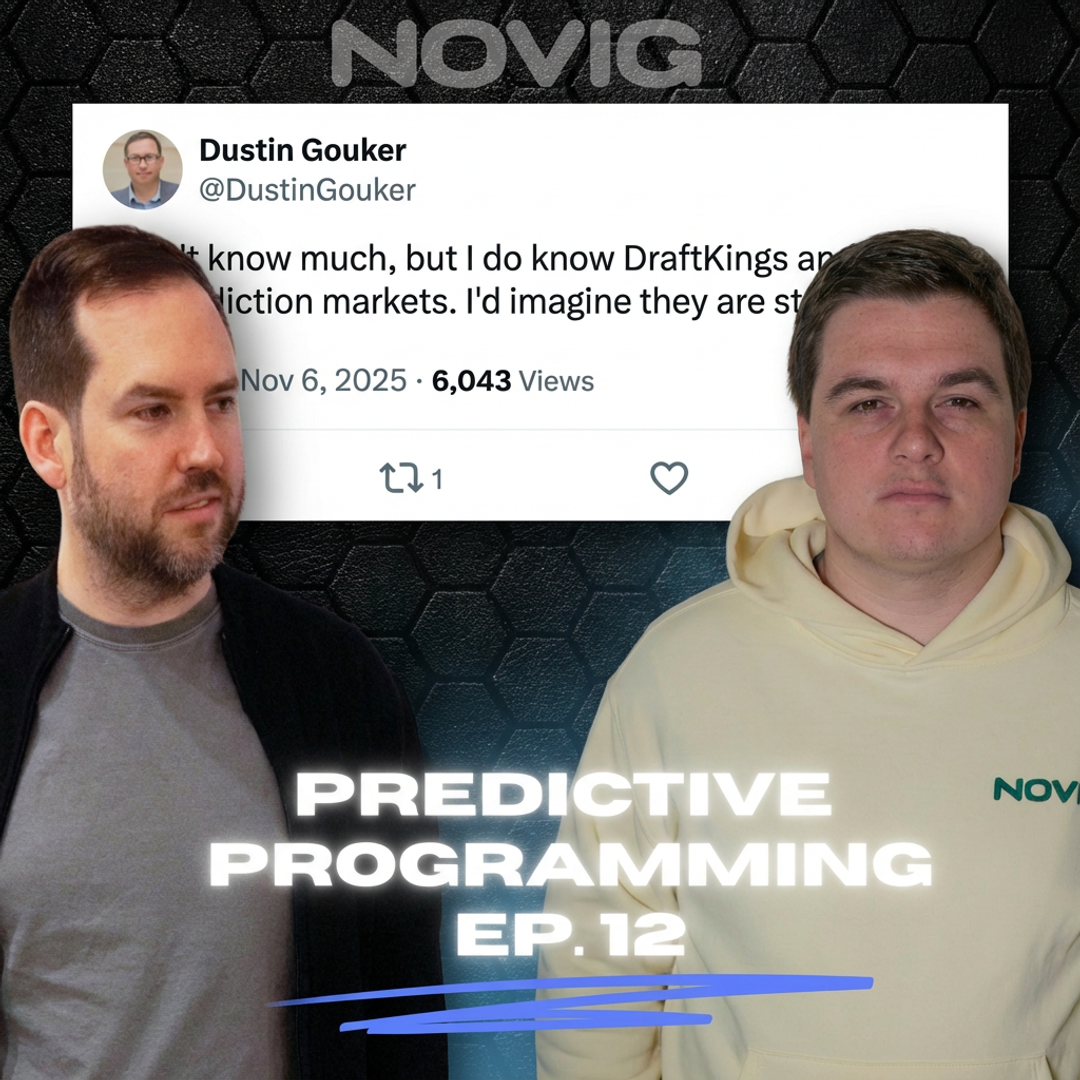
[00:27:27] Speaker B: Let's kind of finish this off on maybe a negative note and talk about our friend.
That tweet was.
[00:27:35] Speaker A: Do you want to read the tweet?
[00:27:36] Speaker B: You want to read it? Yeah, sure, we can read it.
[00:27:38] Speaker A: I'm not going to go super negative on this, but I'll let you cook a little bit.
[00:27:44] Speaker B: You had a very like.
[00:27:46] Speaker A: What was your tweet?
[00:27:47] Speaker B: You said, oh, it's so disingenuous to tweet.
[00:27:50] Speaker A: I said you simply. Well, let me start with her. But I've never read her tweet, so maybe I can read it now for the first time.
[00:27:56] Speaker B: And you tweeted that without reading it.
[00:27:58] Speaker A: Oh, my God.
It's way too long. Sarah Slane, whose title is head of.
[00:28:05] Speaker B: Corporate development at Kalshi, read number eight. That's the key one here.
[00:28:10] Speaker A: Well, it starts. The notion that market makers, which are the backbone of all financial markets, somehow make exchanges similar to sportsbooks is false even in its most generous interpretation.
Even in the most generous interpretation.
So don't give me anything less than the generous interpretation when you come back on this one.
I am skipping ahead to eight. Eight is the thing that everybody seemed to have a problem with.
And maybe we'll have to rewind after all this. Eight on a sportsbook, there is a single centralized entity, the house setting prices for the entire market on an exchange, prices are created from an amalgamation of thousands of bids and asks from thousands of entities.
Market makers, including Kalshi Trading set their own prices as to what they are willing to pay for a contract, but are not able to influence the broader market. Beyond that, the notion that they can is outright false and a complete misunderstanding of how financial markets operate. So first of all, what is the conversation that is going on in prediction market Twitter at large that leads her to write this post, which, by the way, she also posted the same text on LinkedIn. She did.
[00:29:17] Speaker B: Yeah, this is just.
When I, when I see this tweet, I just think it's like you're trying to gaslight me into like, believing that I'm an idiot, which is just like.
[00:29:26] Speaker A: Well, what. What were people saying that made her think she strike this?
[00:29:29] Speaker B: People are saying, you know, the prediction markets are basically sports books, but they're basically sports books. And the market makers operate like sports books, and the market makers control the prices. You can't really win on these prediction markets because you can competing against a market maker, et cetera, et cetera. And I think that's what made.
[00:29:48] Speaker A: You can't win with any more ease than you could win against traditional because of the same quality of counterparty.
[00:29:54] Speaker B: Right.
[00:29:55] Speaker A: Yeah, right. And also perhaps. And this is basically what we talked about with Audi, right? That because there are fee rebates and targets that are only really achievable if you're a serious institutional player.
That it. Functionally, all of the market makers are of a high quality.
[00:30:14] Speaker B: Yeah, I mean, that's what I hate. It's like people like, oh, anyone can get these fee rebates. Okay, well, if the.
If the requirement is you need to post 100,000 liquidity on every single market at $0.02 wide. Well, if your bankroll is like, not like 25 to 50 million, you cannot do that. And then if your bankroll is that high, you must therefore be reasonably good at what you do.
So it's just like, kind of ludicrous to me. And I took a really big issue with this tweet because, look, she's just wrong.
There's just no other way to do it. I don't know if you're gonna come to her defense. Cause you're on the other side. I love her.
[00:30:55] Speaker A: I think everything she's saying is more or less. No, not everything she's saying is true, but I'm a huge defender of the market makers, obviously.
[00:31:04] Speaker B: Yeah, but the way.
[00:31:06] Speaker A: Tell me what you specifically have problems with, because my opinion doesn't matter. Well, yeah, obviously I'm glazing the mm. That's my job. What do you think?
[00:31:13] Speaker B: So, look, the market makers and sportsbooks are extremely similar. First of all, I misremembered it. I thought you said they weren't the same. I was gonna say, I would concede that they're not the same, but they are very, very similar. Because even on a sportsbook like a DraftKings, which prides themself in only taking recreational flow, they do.
[00:31:35] Speaker A: Yeah.
[00:31:37] Speaker B: At a certain point, too much recreational flow will move the line.
[00:31:43] Speaker A: So this is the point in eight that everybody really honed in on this. And so I was kind of surprised that this is what grinded everybody's gears was the idea that any market on a prediction market will trade completely independently of what is happening in the global sports market system. Right. Like the sense that if a market maker moves their line there, it won't move lines anywhere else or vice versa.
[00:32:13] Speaker B: And look, what I would say is.
[00:32:16] Speaker A: I mean, is that what. That's what she's saying?
[00:32:18] Speaker B: Yes, yes. But the thing that's so annoying to me is like, look, they act. They're a centralized house. Yes.
But if DraftKings came out and posted that tonight's game, the Lions vs Ravens, that the Lions were actually the favorite, the Lions were four and a half point favorites.
[00:32:35] Speaker A: That makes sense if you're a Ravens fan. Yeah. Yeah.
[00:32:38] Speaker B: Okay. If The Lions were 4 1/2 point favorites, sure, some people would still click Lions minus 4 1/2 because they are so recreational, they have no idea. But even some of your dumbest recreational customers are going to realize this doesn't make any sense and only bet Ravens on. On like a DraftKings or whatever.
So if that's going to happen, you're now succumbed to the entire market and you aren't really a centralized house.
You are in that you can change the odds, but if you do change the odds too much from the broader market, you're just going to get hammered into place even by your own recreational customers.
[00:33:17] Speaker A: I've said this. Some people say, oh, you know, your openers are copying like this book or that book or whatever. You understand? Like sometimes we will set something off market to start. Like I'll manually go and do this or that.
You immediately get banged into place. Like the market always corrects into this. And then you have this slow process of actually taking. And sometimes you're the first to take the sharp click and you lead and you get some buyback and it's great. Sometimes you're following the market, but like there's no such thing as just hanging some Arb out there. And it's like, what a dynamic ecosystem of different numbers everywhere. Like everybody annihilates it until you congeal. Yeah. Yeah. So, yeah.
[00:33:58] Speaker B: So I just had so much issue with that. And it's like, look, the market makers look.
Okay, so this is. Again, we'll use the same example tonight. The Lions. Ravens is four and a half.
Market makers aren't going to just post that. It's a pick them that's 50% Ravens. 50 or I guess you can buy Ravens at 52% and you can buy Lions at like 52%. They're just not going to do that because they're going to take one way act, they're also going to be succumbed to the market. And furthermore, if their own independent, if they get straight millions of dollars on liquidity on one side, they're going to shift the market too. Just as a sportsbook, if they take one way action on something, they're going to move the number.
So they both act in a very similar way. It is the same.
And for them to sit there and lie like this, either lie or just not have enough knowledge, it just grinds my gears.
So.
[00:34:57] Speaker A: The efficient markets on an exchange are the prize for the market maker. It's a gift to be bestowed.
Hey, would you like to book all the Lions Ravens moneyline action? We all know what the line should be.
We know everything there is to know about Jared Goff and Lamar Jackson and these offenses and these defenses and these coaching staffs. There's no open question to it. It's been open for a week with the highest limits in the world.
All there is to do is to collect a bid, ask spread for volume and a business has to make money.
And one of the nice elegant ways to make money and make money on behalf of your market makers, which if your market makers are you are making money, is to feed them this flow and it is a prize in exchange for quoting all the toxic stuff where you get ran over.
And, and, and so that's one framework and the framework of saying look, you only get rebates if you're doing all this other stuff that makes the product better. Which means that only these, these market makers are willing to do that, get to collect all this flow. That's very fair. And I don't have any sympathy for people who say hey, I just want to show up and quote Monday Night Football, nothing else. Yeah, like you know, go to hell. Like sorry, now you that doesn't mean it has to be that way. Like for instance, on our platform you can do that because we charge no fees and I as a market maker do very little pre game Moneyline volume on this big stuff because it trades $0.01 wide and it's a thing we've opted to do to bring in customers.
I personally can turn a profit trading player props, but it's really hard to.
[00:37:00] Speaker B: Do and you're going to get run over by some very toxic players.
[00:37:04] Speaker A: I get smoked all the time. I hold a lot less than the Theo doing it, but I find a way to do it. And so it's one of the ways we keep the lights on, we keep revenue going and then we have a privileged structure, quote unquote, around parlays.
And then we really build a lot of good parlay product.
And a lot of our volume comes from that and a lot of the P and L comes from that. And we feel like that's fair and it's a thing we came up with that hardly anyone complains about.
If and when we have parlays on these exchanges, they will have to be open and available to everybody to see. But there are a lot of practical realities that'll make that very hard to do. And so I think it's a spot where if the market makers, and then by the trickle down effect or whatever you want to call it, the exchanges themselves are making a lot more money on parlays and it's easier, maybe they can loosen the reins on some of these main markets. And for us, a lot of the decision making is how long are you in growth mode versus when do you actually need to start making money?
If you're in growth mode, you get to say, well, maybe we don't make a lot of money on any of this and we just onboard customers.
So all that is to say, I get the idea of shuffling this around. I've had people reach out and they say, we want to book parlay, you know, like market making groups, we want to book parlays. Can you price parlays? No, but just like if you have people, like, whatever price you think is right, like, we'll book it. I'm like, yeah, you want free money? You want my debit card? Like, I understand what you want. Like, that's not the hard part.
Yeah. So if the hard part exists, then maybe you shift some of the round, but I'm attuned to that. What I think is the issue is, you know, there's like a. I didn't make the meme. I'm going to make the huge mistake of describing a meme. But you think of the classic midwit IQ Belkur and the low IQ take is my counterparty is a real person and this is a fair game.
That's ridiculous. And then the midwit take is my counterparty is SIG and these market makers and I'm going to kill. And the high IQ take is my counterpart is real people and this is a fair game.
And I think there is a level at which you say, like, yeah, the counterparties are hard, but you could be one of them or you could crush them. Like, nobody promised you this was going to be easy. Man up and do the work. And try to win.
[00:39:42] Speaker B: Okay, so in five years from now, when you have all these market makers with deep pockets posting very tight lines with great fee rebates, make it very hard to compete against and you have Johnny appleseed with the 100k bankroll, that is a sharp guy and has grinded his way up. How does he compete? How does he compete?
[00:40:06] Speaker A: Today's Johnny Appleseed is going to be that sharp counterparty five years from now. Some of them, the Johnny Appleseed who plants the most seeds, to extend this metaphor way further than it should go, is.
That's who it is. It's human beings.
It's you. If you can build it, if you can beat it and you can raise the money, like come dominate and do it, like accept the challenge, don't insist that it be made easier. It's ridiculous to say, like, I love this product, but it has to be really easy to win.
The terms of the deal are too difficult. I have to be the best. Yeah, go be the best.
Man up now.
[00:40:46] Speaker B: It's easy for you to stay on the other side though.
[00:40:48] Speaker A: No, it's not easy for me. I've worked my ass off to be able to do it at all. This is not an easy thing to build, but I have no patience for somebody who has not tried as hard as me, who feels entitled to just as much P and L.
Sorry, that's not what this is.
Anyways, that being said, you do have customers at every point on that bell curve and you have to find a way to speak honestly to all of them because you are trying to tell a story to the kind of novice person of, hey, this is different.
This is peer to peer in some regard and you can't start getting into the complications yet. And yet you have to be able to tell that story. And honestly, your critics should be willing to give you a little bit of room to tell that story because that is what warms people up to the exchange idea and brings them in. I mean, there are insanely sharp people who are some of the best betters, bookmakers, traders in the world who are still afraid of trading sports on exchanges and prediction markets because they think that they're going to get run over to start right, like, and, and you. We have to kind of as, as businesses, we have to soften that a little bit and, and tell some story where it's like, guys, you're going to have fun. This is a good time.
You have to be able to address that. You have to be able to talk to the people who are seeing the parallels that, like, actually, this is not free money, honestly. And say, of course it's not. Of course your competition is tough, but it's fair and it's full of friction and new opportunity. And if you just throw your hands up and give up right away, of course you're going to lose. This isn't a product for people who give up right away.
This is a product for people who grind.
And that's the way you need to talk to people. And I think anybody would be shocked.
[00:42:41] Speaker B: I feel motivated.
[00:42:42] Speaker A: Yes. Come on, let's go.
That you can talk to your users this way and they appreciate being respected and that's what you have to do. And I hope.
Well, you know what? I hope nobody else figures it out and I keep doing it and we can get some alpha out of it. That's my opinion.
[00:43:00] Speaker B: That's fair. I think we can leave it at that.
[00:43:02] Speaker A: All right, we'll wrap up.
We've got some ideas for upcoming episodes. We'll talk about it later. We'll tweet about it.
[00:43:08] Speaker B: We're out.